



Overview
Comet 3I/ATLAS is a very special object because it did not come from our solar system—it came from outer space, beyond the known planets. It is only the third interstellar object ever observed passing near our solar neighborhood.
Astronomers have confirmed that it is interstellar because its orbit is hyperbolic—meaning it isn’t moving in a circular or oval path around the Sun like normal planets or comets. It will pass through our system just once and then be driven back into space.
This comet will not come very close to Earth, and there is no danger. It will pass approximately 1.8 astronomical units (AU) away from us—at a distance of around 170 million miles (270 million kilometers). It will come closest to the Sun on October 30, 2025, when it will be approximately 1.4 AU (around 130 million miles or 210 million kilometers) away—within the orbit of Mars.
Astronomers around the world are studying this comet to understand its size, shape, and material. It will remain visible with telescopes until September 2025, but after that, it will move closer to the Sun and become difficult to see. In early December 2025, it will again be visible on the other side of the Sun, and scientists will continue to observe it.
Discovery
This comet was discovered on July 1, 2025, by the ATLAS telescope (Asteroid Terrestrial-impact Last Alert System) in Rio Hurtado, Chile.
Following the discovery, the telescope team sent its report to the Minor Planet Center, which officially confirmed that it was a new comet. Later, astronomers examined old telescope images and found pre-discovery photos of this comet. These images were found in data from the ATLAS telescopes and Caltech’s Zwicky Transient Facility (Palomar Observatory, California). The oldest image was recorded on June 14, 2025.
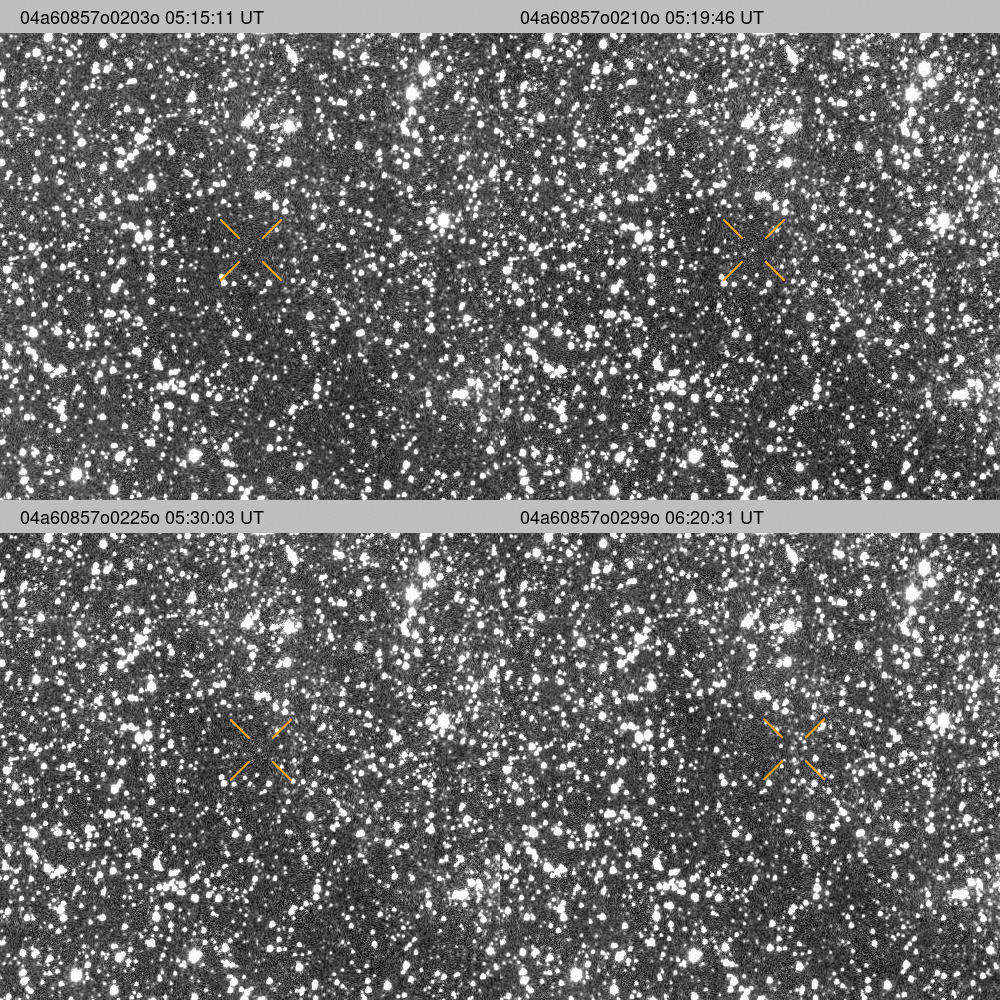
Why the Name “3I/ATLAS”?
- ATLAS – The name of the telescope team that discovered the comet.
- I – Stands for interstellar, meaning it came from outside our solar system.
- 3 – Indicates that it is the third interstellar object discovered so far.
NASA Observations
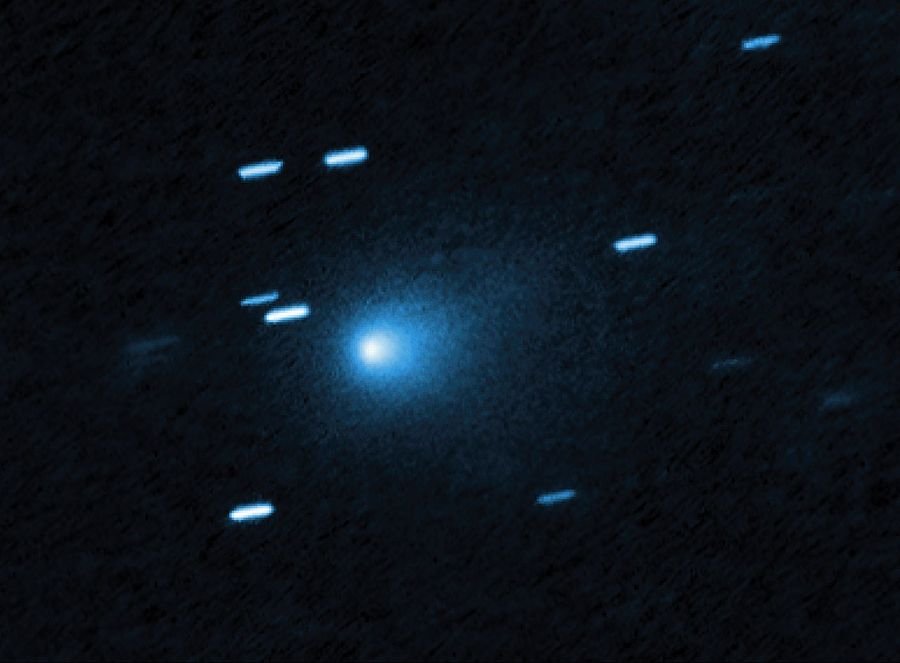
NASA is using its most powerful telescopes and spacecraft to study Comet 3I/ATLAS. On July 21, 2025, the Hubble Space Telescope took a clear image of the comet when it was 277 million miles (446 million kilometers) from Earth. In the photo, Hubble revealed a teardrop-shaped dust cloud surrounding the comet’s icy solid core (nucleus). Because the comet moves very fast, the background stars appear as streaks in the photo.
Based on Hubble’s detailed images, astronomers estimated the comet’s size. As of August 20, 2025, its nucleus could be approximately 3.5 miles (5.6 kilometers) wide—or as small as 1,444 feet (440 meters).
NASA Missions Watching 3I/ATLAS
- Hubble Space Telescope
- James Webb Space Telescope (JWST)
- TESS (Transiting Exoplanet Survey Satellite)
- Swift Observatory
- SPHEREx Mission
- Perseverance Mars Rover
- Mars Reconnaissance Orbiter
- Curiosity Rover
- Europa Clipper
- Lucy Mission
- Psyche Mission
- Parker Solar Probe
- PUNCH Mission
- SOHO (ESA/NASA)
- JUICE Mission (ESA/NASA)
All of these missions are helping scientists understand how interstellar comets form and travel, and what they can teach us about other star systems.
In Simple Terms
Comet 3I/ATLAS is a visitor from another solar system, passing through ours for a brief time. This rare event gives scientists a chance to study what exists beyond our Sun and planets. Although it poses no danger to Earth, it represents a valuable opportunity for astronomers to study a traveler from the deep universe. Such cosmic moments are truly extraordinary.