


Introduction
New breakthroughs are happening every day in the world of technology. Artificial Intelligence (AI) has already taken the world by storm—chatbots, automation, self-driving cars, and healthcare innovations are just a few examples. But AI also has limitations. The power of traditional computers and GPUs is limited when faced with very complex problems.
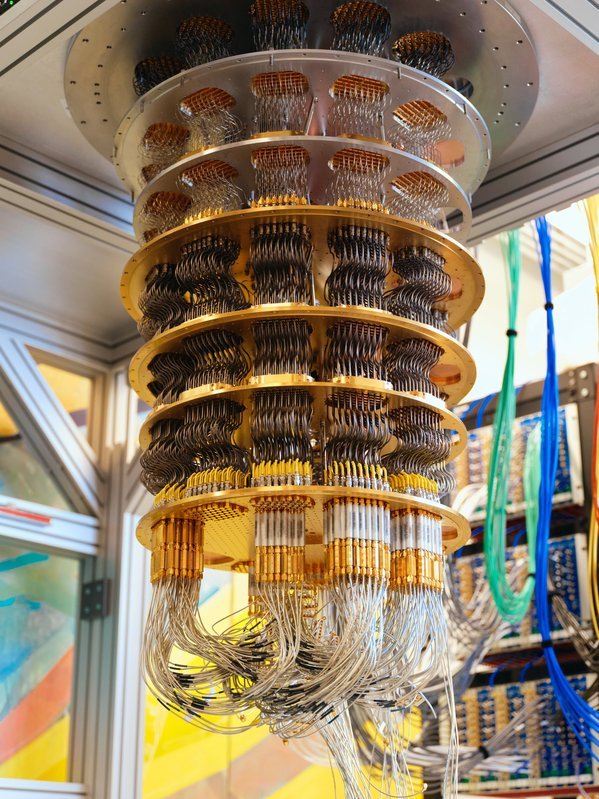
Quantum Computing is here to fill this gap. It is a revolutionary technology that uses the principles of quantum physics to process data with unimaginable speed and accuracy. And when quantum computing and AI come together, the possibilities are literally limitless.
In this article, we will explore in detail how the partnership between quantum computing and AI works, its future, its impact on industries, and its challenges.
What is Quantum Computing?
Normal computers use a binary system—0 and 1. Every computation occurs using these bits. But quantum computers use qubits (quantum bits).
A qubit can be both 0 and 1 at the same time (thanks to superposition), and multiple qubits are interconnected with each other (entanglement), which exponentially increases their computational power.
Example:
A normal computer will check 1 million solutions to a problem sequentially.
But a quantum computer can check all solutions in parallel at the same time.
What is Artificial Intelligence?
AI essentially makes machines smart—learning, reasoning, and making decisions from data. Large Language Models (LLMs) like ChatGPT, Google Gemini, or Bard are already powerful examples of AI.
But training AI models requires a lot of data and computational power. Limitations arise here, too, which is where quantum computing comes in.
Why is the Quantum + AI Partnership so Powerful?
- Quantum Speed-Up → Data processing becomes exponentially faster with quantum computers.
- Smarter AI Learning → Neural networks and ML models can be trained faster and more efficiently.
- Better Optimization → Quantum optimization algorithms help AI choose the best solutions.
- Advanced Simulations → Realistic simulations are possible in sectors like drug discovery, climate modeling, and logistics.
👉 In simple terms: AI is smart, but slow. Quantum is fast, but still limited. Together, they create a super-fast and super-smart system.
Timeline: Evolution of Quantum AI
- 2010–2018: Rapid growth in AI due to big data and GPUs. Quantum computing was still in the lab stage.
- 2019–2022: LLMs like ChatGPT and GPT-3 arrived. Small breakthroughs in quantum computers.
- 2023–2024: Quantum AI research accelerated. IBM and Google launched their quantum processors.
- 2025 onwards: Adoption of quantum + AI has begun in real-world workflows (finance, healthcare, logistics).
Quantum + AI Together: Real-Life Use Cases
1. Healthcare 🏥
- Drug discovery, which normally takes 10–15 years, could be possible in weeks or months with quantum AI.
- Personalized medicine, where custom treatments are created by analyzing a patient’s genetic data.
2. Finance 💰
- Stock market predictions with higher accuracy.
- Fraud detection will become real-time.
- Next-level accuracy in risk management and portfolio optimization.
3. Climate Research 🌍
- Weather forecasting and global warming predictions will become more accurate.
- Complex simulations of climate change were impossible until now, but will now be possible.
4. Transportation 🚗
- Smart traffic systems that minimize congestion.
- Logistics and supply chain me route optimization with minimal costs.
5. Cybersecurity 🔒
- Unbreakable encryption possible with Quantum AI.
- Cyberattacks can be instantly detected and blocked.
Key Features of Quantum + AI
- Massive Processing Power → Solving problems which are currently impossible.
- Faster AI Training → Models will train in days or hours instead of weeks.
- Advanced Simulations → New discoveries in Physics, Chemistry, and Biology.
- Optimization at Scale → accurate solutions for large-scale industries.
Challenges That Exist
- Technology Is Still in Its Infancy → Quantum computers are still in the experimental stage and have not yet become practical on a large scale.
- High Cost → It costs millions of dollars to build and maintain a quantum computer.
- Error Rates → Quantum systems are sensitive; even small changes in the environment can lead to errors.
- Skills Gap → Quantum + AI experts are very few. There is a talent shortage in this field.
Future Roadmap
- Hybrid Systems: Classical and quantum computers will work together.
- Quantum Cloud Services: Companies like Google and Microsoft will offer quantum-AI tools in the cloud.
- Industry Breakthroughs: Healthcare, climate, and finance are the first to transform.